30 October 2010

Contamination

Smog Over Eastern China, September 2005

There are five great challenges that must be addressed in the near future if the world is to meet its water needs without war, famine, demographic collapse, and possible social collapse:

1) Climate Change
2) Population Growth
3) Increased Standards of Living
4) Water Management Institutions
5) Contamination

In some respects, contamination is the best known and studied of these challenges, for at least since the emergence of the environmentalist movement in the 1960s, individuals, institutions and governments have become aware of and sensitive to matters of contamination. In many nations large government departments like the Environmental Protection Agency in the US have been established in an attempt to halt further contamination of water bodies and, where possible (think Superfund in the US) to mitigate past contaminations. In the richer and longer developed nations of Europe and North America, those departments have had some success in both preventing additional contamination and cleaning-up at least parts of the worst cases of past contamination.

The recent rapid economic growth in China, with hugely increased demands for water because of industrial and agricultural uses, has pointed to the horrifying problem of contamination of its waters. The Friday 29 October 2010 issue of the right-wing Washington Post (WP), a paper where international coverage is normally non-existent or mediocre, contains an insightful article on the contamination of a large lake not far from Shanghai, Tai Lake. Near the mouth of the Yangtze, the lake is recipient of agricultural and human waste contaminants from upstream, with more contamination coming from areas near its shores resulting in an overload of contaminants, not least Nitrogen (N), in forms that promote the growth of algae. The lake is now nearly covered with toxic forms of the simple organisms making its waters foul smelling, largely useless for agricultural and industrial purposes, destructive of its fish once used for food, and generally making the water unsafe for human consumption. While I rarely recommend the WP as a useful information source, this article is worth a read.

29 October 2010

Pakistan Flooding - the Aftermath

Flood waters on the Indus at Kotri, barrage 19 August 2010

The Pakistan floods came just after I collected material on the problems of water supply in that predominantly arid country. The plan was to discuss Pakistan's problems resulting from a growing demand for water in the face of a diminishing supply. Instead of suffering from the problems of drought, in 2010 Pakistan was inundated by record rainfall with the Indus and its various tributaries flooding much of its best agricultural land, washing away crops and soil in productive agricultural areas and drowning parts of several large urban places and countless towns and villages. The lives of millions were disrupted, and the wet season crops of 2010 will be a small fraction of the expected yields in some of the more productive farming areas as flooding washed soil and growing crops off the fields and devastated irrigation facilities.

The flooding has now subsided, and post-flood recovery in Pakistan is largely absent from the world's news media. Today's (30 October) Guardian newspaper from Britain has a fine piece on the problems of recovery by Mohamed Hanif "Forgotten but not gone." Even as in the recent past the US has promised Pakistan's military about $2 billion in military aid, it is contributing a vastly smaller amount for food aid and reconstruction of infrastructure damaged and destroyed in the flooding. Yesterday the BBC reported "Pakistan Flood Food Running Out." With crops far below usually production, the country will need food supplies to carry it through to the next harvest. In addition a huge amount of resources will be needed to reconstruct houses, warehouses, transportation facilities, irrigation canals, and the other elements of life the flooding destroyed.

Discussions of a world water crisis rightly emphasize problems of water supply, and in most of the countries where a water crisis looms, the availability of adequate quantities of water is the key issue. With global climate change, some regions will be faced with additional rainfall and others will suffer from irregular and occasionally excessive precipitation - likely to be the case in much of the Indian subcontinent. A not inconsiderable portion of the subtropics may face wild fluctuations in precipitation year to year. They may then have occasional years like 2010 in Pakistan with damaging and dangerous flooding followed by numerous years with precipitation inadequate to meet basic water needs.
Enhanced by Zemanta

27 October 2010

Responses to Questions from class 27 October

Mendoza, Argentina
©eop

Some brief responses to several questions raised in class on 27 October:

I. Dam Licensing. Most dam licensing in the United States is by the Federal Energy Regulatory Commission.

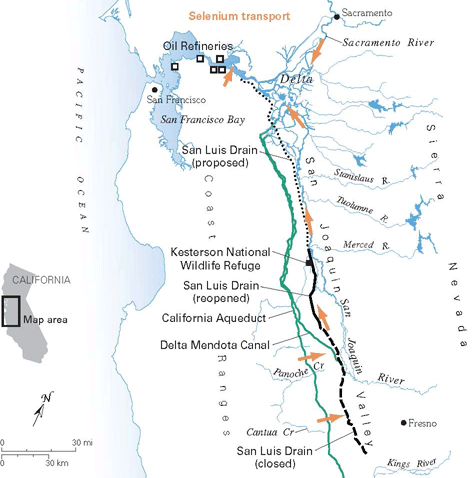
Draining Selenium Tainted Water from San Joaquin Valley
Source: USGS

II.  Selenium and irrigation in California.
The accumulation of selenium (Se) in the waste water draining from irrigated fields in the San Joaquin Valley has become a major problem in California water management, especially as there are only two readily available outlets for the waste water, 1) a  flow into the Sacramento Delta where the waste poisons water destined to be pumped into the California Water Project and then into San Francisco Bay where it threatens wildlife or 2) flow into the interior basin near Hanford where the water evaporates and the resulting brine and dusty soil have truly toxic levels of Se. Selenium and the San Joaquin Valley, a power point presentation from the Geochemistry program at the University of Arkansas, illustrates the sources of selenium and the problems associated with it. There have been a number of proposed solutions to the problem, including a drain into San Francisco Bay (see map above). The problem is far from resolved, and no easy solution is in sight.

Sacramento Delta

III. Salinization of the Sacramento Delta.
Drought caused low water flows and the heavy duty withdrawal of water from the Sacramento River for shipment southward has led to salt water intrusion into the large delta area at the mouth of the Sacramento Rive, the zone where it flows into San Francisco Bay. That salt water intrusion, in turn, threatens the quality of the water drawn into the San Luis Reservoir at the Harvey Banks Pumping Plant near Tracy in San Joaquin County on the edge of the Delta. The State of California has a Bay-Delta Conservation Plan which illustrates the various options currently under consideration to move water from the Sacramento River around the Delta so that it does not pick up salt. Only in California could a water movement proposal this expensive be given serious consideration!
Enhanced by Zemanta

26 October 2010

Urban Water III

Fountain, City of London
©eop

Today's New York Times has a good op ed piece by its regular columnist Bob Herbert concerning the pressing need for investment in urban water supply facilities. While urban uses account for less than 10 per cent of total water use, it is a crucial percentage, supplying the basic needs of millions of US citizens and residents. Saving some or most of the 10-20 per cent of water in urban systems currently lost to leakage would itself justify a large investment in new and renewed facilities, especially in cities where some of the water (and waste removal) infrastructure is over a century old. It would in most circumstances be far cheaper than expanding the supply system to bring in that much more water. Herbert further justifies the investment because it would create jobs and new opportunities for private enterprises. 

Whether the latter points are correct or not, huge investment is going to be essential in the next decade merely to maintain current standards of safety and reliability. Otherwise we are going to see many more events like those that have plagued the Maryland water utilities serving the Washington, DC slurbs. The WSSC in Maryland, in comparison to many urban and slurban water utilities elsewhere, runs a relatively new and up-to-date system. Despite that, it has suffered several major crises over the past couple of years. In those systems which are rapidly aging, it is only a matter of time before a colossal fire in one and in another one an epidemic of water borne disease happens because the water systems are beyond the breaking point, broken and dilapidated. 

25 October 2010

Sudan, the Nile and the Merowe Dam


The nearly always amazing NASA Earth Observatory chose this image of a dam in the desert on its site this morning as its Image of the Day. The accompanying brief article is well worth a read, for it encapsulates the problems of water supply and management in an extremely arid environment with a growing population. It also points to some of the problems of dams in the region and the conflicts over the use of the Nile, crucial for life in both Sudan and downstream Egypt.

20 October 2010

Climate Change and Drought


Source: NCAR
Yesterday 19 October 2010 the Universities Corporation for Atmospheric Research (UCAR) issued a press release describing its work on the water supply aspects of climate change:  Climate change: Drought may threaten much of globe within decades.  The release and the research on which it is based provide yet more evidence, as if such were needed, of how critical climate change is to the human future. No, agriculture cannot simply move from Iowa to northern Manitoba for all to be well! The drying out of middle latitude zones is ominous indeed and does not bode well for maintaining a decent standard of living for the world's increasing human population. The online version of Scientific American has an interesting article based on the UCAR report.
Enhanced by Zemanta

16 October 2010

The Desiccation of the Aral Sea


The Death of the Aral Sea

In the slide set on water footprints we used last session, there was a photo of fishing boats stranded in a desert, at the bottom of what was once a large saline lake, the Aral Sea. Similar to the Great Salt Lake in Utah or the Dead Sea, the Aral sea filled the lowest part of an interior basin with not outlets to the world ocean, but it was far less salty than those two inland seas because it received a much larger annual input of fresh water. Prior to the mid 1970s, it was an important supplier of fish to nearby areas and to the larger Soviet Union. As the lake has dried, the remaining water has become more saline, and many fish species that once flourished have been extinguished, unable to survive in the Aral Sea's remaining and increasingly briny waters.

During the Soviet era there was a huge push to increase crop production in the Central Asian republics, and in particular the production of cotton. The streams flowing from the Hindu Kush mountain range far to the south and east, in particular the exotic rivers the Amy Darya and the Syr Darya, were diverted to irrigate cotton fields.Most of that water has been lost to evapotranspiration, and the rivers now bring virtually no additional fresh water into the Aral Sea. The pictures above show the desiccation of the Sea, almost entirely due to diversion of streams feeding into it. The USGS has a good website describing the desiccation along with some additional photos. 


Enhanced by Zemanta