Showing posts with label contamination. Show all posts

30 October 2010

Contamination

Smog Over Eastern China, September 2005

There are five great challenges that must be addressed in the near future if the world is to meet its water needs without war, famine, demographic collapse, and possible social collapse:

1) Climate Change
2) Population Growth
3) Increased Standards of Living
4) Water Management Institutions
5) Contamination

In some respects, contamination is the best known and studied of these challenges, for at least since the emergence of the environmentalist movement in the 1960s, individuals, institutions and governments have become aware of and sensitive to matters of contamination. In many nations large government departments like the Environmental Protection Agency in the US have been established in an attempt to halt further contamination of water bodies and, where possible (think Superfund in the US) to mitigate past contaminations. In the richer and longer developed nations of Europe and North America, those departments have had some success in both preventing additional contamination and cleaning-up at least parts of the worst cases of past contamination.

The recent rapid economic growth in China, with hugely increased demands for water because of industrial and agricultural uses, has pointed to the horrifying problem of contamination of its waters. The Friday 29 October 2010 issue of the right-wing Washington Post (WP), a paper where international coverage is normally non-existent or mediocre, contains an insightful article on the contamination of a large lake not far from Shanghai, Tai Lake. Near the mouth of the Yangtze, the lake is recipient of agricultural and human waste contaminants from upstream, with more contamination coming from areas near its shores resulting in an overload of contaminants, not least Nitrogen (N), in forms that promote the growth of algae. The lake is now nearly covered with toxic forms of the simple organisms making its waters foul smelling, largely useless for agricultural and industrial purposes, destructive of its fish once used for food, and generally making the water unsafe for human consumption. While I rarely recommend the WP as a useful information source, this article is worth a read.

09 August 2010

Smoke, Trash and Dams

Three Gorges Dam, Yangtze River, China under construction below and nearly complete top

When it was proposed and during construction of the Three Gorges Dam, many commentators said it would fail to stem the floods for which the Yangtze is notorious. Since its completion the rains of summer 2010 mark the first season of precipitation greatly in excess of long-term averages, and events of the past two months would seem to prove their point. There has been substantial flooding both above and below the dam. Although the Chinese authorities claim the dam itself is sound,  it has been able to hold back only a small part of the additional flow of the massive river. Devastating flooding has wiped out towns and villages, farm fields, and transportation facilities both up and downstream from the world's largest barrage. Built for all four of the magic goals of dams, for the foreseeable future the Three Gorges Dam may fail at three of them, flood control, navigation, and hydroelectric generation, while the rains make the final one, irrigation, unnecessary.

Much of the detritus caused by the flooding, it turn, has washed into the river, and the dam has blocked that material coming from upstream in much the same way that it blocks silt in periods of normal flow. Upstream of the dam the accumulating trash in the reservoir, already about a meter thick and strong enough to form islands capable of supporting a person, could clog a floodgate and threaten the integrity of the dam itself, but more likely is blockage of the navigation locks (right hand side of the pictures) and fouling of the water flowing over and through the dam with trash that makes downstream use difficult. There are dire predictions about navigation dangers on the river, a crucial route for Chinese commerce, due to the accumulated trash. Upstream, the immense city of Chongqing (Chongqing (重庆; Chóngqìng formerly spelled Chungking), may have to draw water into its public supply that has been fouled by industrial and agricultural chemicals, farm waste, and human sewage. Rapid flow would serve to dilute those pollutants if the river had been left undammed, but the slack water behind dams results in far less mixing of waters and dilution of pollutants.

Meanwhile, at the opposite end of the rainfall spectrum, the severe drought and excessive heat that have plagued European Russia for most of the summer of 2010 have resulted in some serious problems of heat and smoke in the capital. Moscow, a city where air conditioning is rare because in the past it has been needed infrequently, has suffered multiple days with 35+ degrees Celsius. In addition to the heat, Muscovites are breathing air with dangerous levels of smoke, soot and other pollutants, a consequence of field, brush and forest fires, some of them burning down into the layers of peat beneath birch woods and brush lands surrounding the city. Peat, used as a fuel in several parts of the world, can smolder and burn for a long time once ignited, and until drenching rains or the winter cold begins, smoke will continue to plague Moscow even when temperatures moderate.

Most Russian grain is rain-fed with no supplemental irrigation, and the combination of drought and fires have devastated the 2010 crop. World grain prices have soared because analysts expect the grain crop in Russia to be far smaller than usual, and that country has banned grain exports. Increases in grain prices could spark serious food problems worldwide.Should the Argentinian and Australian grain areas suffer serious drought in the 2010-11 growing season, the year of 2011 could have a food crisis.


Temperature anomalies in Russia, Summer 2010

As always one must remember that the events of a single summer say nothing about climate change, but the flooding in Pakistan and China and the drought and heat in Russia are precisely the kinds of conditions that warmer earth temperatures point toward. Those include long spells of hot weather in many northern hemisphere cities, redistribution of precipitation with increases in some areas and deficits in others, and an increasing frequency of extreme weather events including both drought and torrential rainfall.
Enhanced by Zemanta

07 August 2010

Minerals, Mining, and Water II: Hydraulic Gold Mining in California


"Hydraulic Mining, Behind the Pipes." 

Several months ago I purchased a copy of Isenberg, Andrew. 2006. Mining California: An Ecological History (New York: Hill & Wang, ISBN 0-8090-6932-6) at a used book sale. I have an ongoing if rarely pursued interest in the history of the far western US and in mining as a part of that history. Over the past few very hot days, stuck at home waiting for plumbers, I have been reading the fine and fascinating book. The early history of California is intimately tied to mining, and more than 100 years after the last hydraulic mines closed, scars remain on the landscapes of the Sierra Nevada foothills in "Gold Rush Country." Hydraulic mining techniques were widely used after about 1855, as water at high pressure was sent through nozzles pointed at loose sediments known or expected to contain gold nodules. The resulting mud was then run through screens and placers which separated out the valueless sand and gravel and left behind much of the heavier gold and other valuable minerals. (Not all of the gold was recovered, and there is a small but thriving present day business reprocessing the sand and gravel to recover the precious metals early mining left behind in deposits of sand and gravel like the one shown in th photo at the end of this posting).

In order to feed the high pressure nozzles, a great deal of water was needed, and to assure pressures high enough to wash the loose sediments into sluices, dams and aqueducts were built higher up on the streams. Not a few of those dams were poorly engineered or shoddily constructed, and there were several catastrophic dam breaks flooding downstream areas and killing miners unlucky enough to be in the path of the water flowing downhill. Vast quantities of materials were displaced by the technique, and among several consequences rivers once running clear were turned into thin mud flows. Salmon runs in those rivers ended, and San Francisco Bay received large quantities of silt. The already flood prone Sacramento and San Joaquin Rivers, near sea level in their final kilometers where they meet in the delta, flooded more often and more catastrophically. Closer to the mines, towns had to find alternate water sources as the water was too muddy and contained toxic metals dissolved at and downstream from the workings. Hydraulic mining was finally banned in 1884 by a decision of the federal 9th Circuit Court.

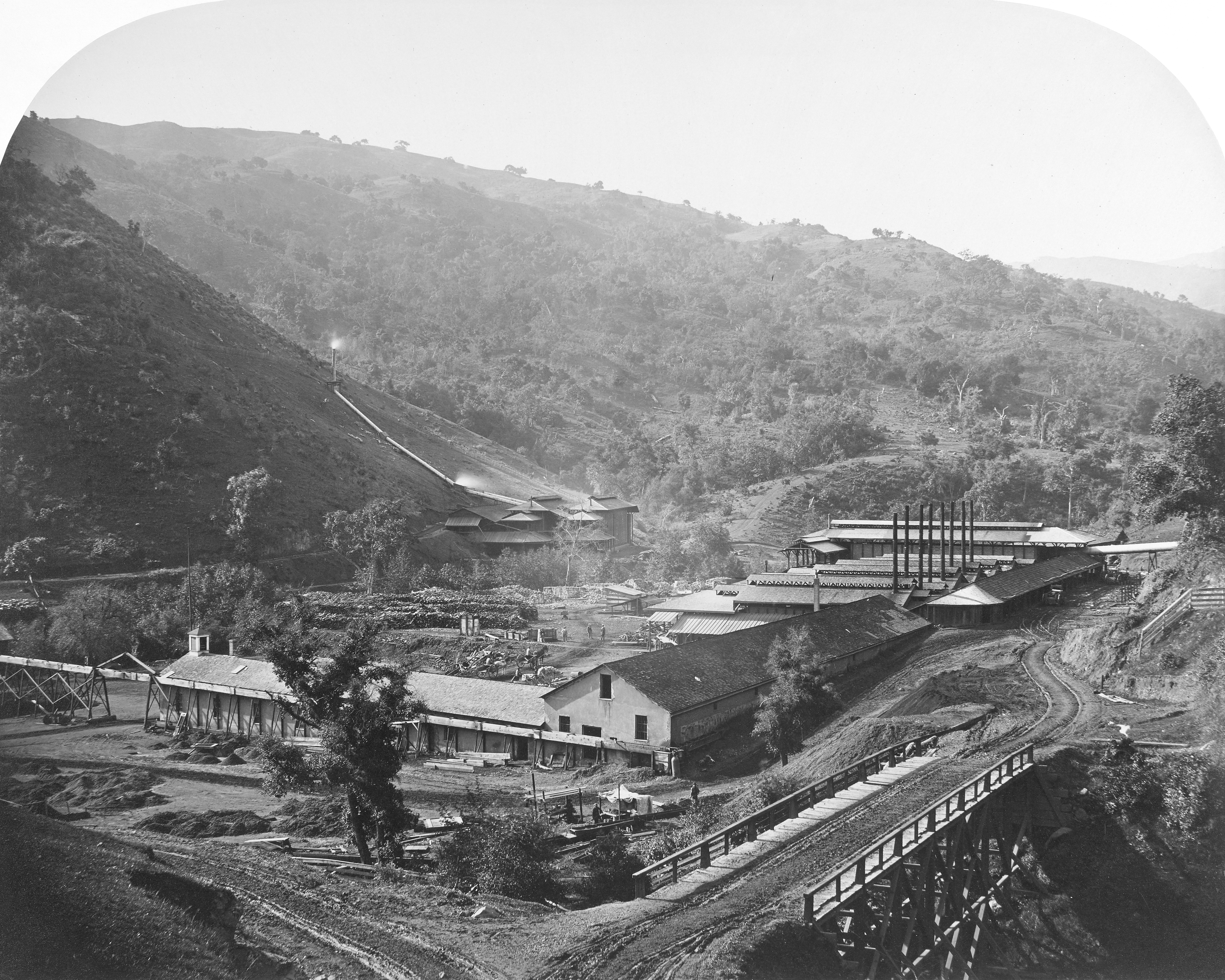
Traces of mining history remain in the water supply of those streams where water melted from the Sierra Nevada snowpack and flowing through the rivers of the gold region was used in hydraulic mining and today is the water supply for much of California's 37 million people, its industry, and its agriculture. Gold and other precious metals were the magnets attracting miners to the state, but California was also one of the world's major producers of mercury, chemical symbol Hg, at the New Almaden mine in the Coast Range mountains near present day San José in Santa Clara County and at New Idria in San Benito County about 100 km south. Mercury in most of its common forms is toxic to humans, domestic animals, and much plant life, and in some forms only a small exposure to mercury is needed to have toxic effect.
New Almaden Smelting Works, 1863
Source: Wikipedia

The proximity of the mercury source, it is less than 500 km between the New Almaden mine and most of the gold workings in the Sierra foothills, made an amalgamation process of mining popular. Gold (as well as silver and several other valuable metals) will dissolve in mercury. Once a quantity of ore is dissolved in a flask of mercury, distillation drives off the mercury, which can then be condensed and reused, leaving behind the desired gold. While the mercury fumes were highly toxic to anyone who happened to breathe them during the distillation, the process was inexpensive and thus popular. It was far from perfect, and lumps of mercury contaminated material were deposited in the detritus of hydraulic (and other) mines. Over time some of that mercury has leeched into the flowing waters of streams and contaminates nearby rivers. Occasionally health authorities ban use of the water for domestic purposes because of mercury contamination. In California with perennial water supply problems, mercury contamination of some of its more reliable streams remains a serious and ongoing problem.

Cone of hydraulic tailings on Wedge Gulch, The tailings were partly caught by a restraining dam, and the mass afterward eroded when the dam gave out. Big Trees quadrangle, Calaveras County, California. 1905. Published as plate 5-A in U.S. Geological Survey. Professional paper 105, 1917.
Enhanced by Zemanta

05 August 2010

Petroleum, Pipelines and Water

Whittier Oil field, wells along property line of Central Oil company and Murphy Oil company. Looking east. Los Angeles County, California. 1905. Plate 13-A in U.S. Geological Survey. Bulletin 309. 1907.

My expectations of more oil flooding out of the breech in the Gulf seem to have been misplaced, and the ongoing process of sealing the well ("static kill" in the lingo of the trade) seems to be working. Moreover, we are told by the EPA that a large fraction of the oil that gushed from the breech has now dissipated. I hope the EPA statement is true, but I fear in the not too distant future oceanographers of various stripes will find it to have been an over rosy evaluation of what future environmental historians are likely to describe as one of the greatest ecological catastrophes since the beginning of the industrial revolution. Anyway, the effects of  the BP spill on fresh water were minimal, and its effects on food supply through the contamination of one of the most important source areas for seafood should be clearer before the food course begins in the Spring.

Petroleum is not out of the water supply picture, however, nor is it likely to be until the age of petroleum ends. A pipeline leak in Michigan has contaminated the Kalamazoo River, a stream flowing into Lake Michigan, the primary water source for Chicago, Milwaukee, and many smaller communities. The Enbridge Spill, named after the pipeline company operating the breeched pipe, has been estimated to have dumped more than 3,755,00 liters (1 million gallons) of crude oil  into the river, causing some nearby residents to be evacuated and restrictions to be placed on the use of the river for water supply and recreation. It is lucky that no nearby large town uses the river as its major source of water!

Enbridge Michigan Pipeline and Spill Location

The Enbridge spill has not, as far as we know, killed or even seriously injured anyone. In 1999 a rupture in a gasoline pipeline sent that flammable liquid downstream in Whatcom Creek in the city of Bellingham, Washington. Three youths were killed, two of them while playing with the matches that ignited an immense explosion. The third victim was a recent high school graduate celebrating the arrival of warm weather with a afternoon of fly fishing downstream from the Olympic Pipeline spill at Whatcom Falls Park, probably killed by the fumes before his body was incinerated by the fire. Whatcom Creek flows, partially underground, near the center of Bellingham enroute to Puget Sound. Gasoline entered the city's sewers, and there was a realistic fear that much of the picturesque center of Bellingham would explode in a huge fireball. A number of structures in Bellingham were damaged, and the pumping plant at a sewage treatment facility on Whatcom Creek was all but completely destroyed. Indeed the Bellingham area, often ranked as one of the most desirable places to live in the United States, has an unfortunate relationship to oil and oil pipelines. Earlier this year 7 workers were killed in an explosion at an oil refinery about 50 km away, and since the events of 1999 the city has been on edge each time a spill has been reported, including a large underground one in 2007. Facing one of the most beautiful but also one of the most heavily utilized portions of Puget Sound, the city is also acutely aware of the possibility of a maritime accident, including one in Canadian waters less than 100 km distant, though a May 2010 article in the major Vancouver, BC newspaper thinks tanker leakage is unlikely.

View of smoke from Whatcom Falls Gasoline Spill, 1999

The old axiom that oil and water do not mix has considerable resonance in any discussion of water supplies. Neither the Gulf nor the Bellingham spills directly impacted on the supply of fresh water, though the Bellingham spill and subsequent explosion and fire did destroy a sewage treatment facility. It seems only a matter of time until an oil pipeline passing across a stream breaks and renders the stream unfit for use in the water system of some large city or another. A break in a pipeline or other large spill involving the Ohio or the Mississippi could render water from those rivers unfit for consumption for hundreds of miles and would all but inevitably affect a large city.

[At home we are suffering a water supply problem! A leaking hot water tank and a malfunctioning shut off valve for that tank means the water to the house is shut off until the plumber can fix it later in the day. Hardly equivalent to even a tiny part of the suffering of that fifth or more of humanity who lack access to adequate water, but it does generate more sympathy for them.]

13 July 2010

Notes

Windmill, Pacific Ocean near Todos Santos, BCS, Mexico 2009
©EOP

Occasionally I shall post some random notes about issues, comments that do not fit together coherently. This is the first such posting.

This morning I was looking for some materials on local water concerns to use with the course, and I learned of a problem which was new to me. Fairfax City includes within its boundaries a sizable tank farm, a gasoline and diesel fuel depot. In 1992 there was a large underground spill that sent gasoline and other petroleum derivatives in a plume far downstream into the Mantua area of Fairfax County. That leakage cost a huge amount of money spent to clean up impacts in a scenic and generally uparket residential area. I had not paid attention to a much smaller leakage found in late 2009 which has not yet been fully cleaned up. The leak is fairly small, but it marks yet another insult to the land and waters of the Potomac Basin.

Several weeks ago I read reviews of James Lawrence Powell's Dead Pool (Berkeley: University of California Press, 2008, ISBN 978-0-520-25477-0), a  history and analysis of the dams on the lower Colorado especially Glen Canyon and Boulder Dams. The reviews were correct, for it is one of the most important books on water issues in the United States published in the past decade and should be required reading for almost everyone concerned with water supply in an era of population growth and climate change. The first few pages describing what might have happened if Glen Canyon Dam had failed in 1983 make for harrowing reading. The remainder of the book examines how the dams have shaped life in the southwestern corner of the continental US (and in adjacent parts of México) and what may happen as rainfall decreases due to climate change, reading almost as harrowing as the first few pages.