Showing posts with label dams. Show all posts

01 November 2010

Dams III - Dam Removal

Aerial view of Elwha River Dam, Washington State

As they age, fill with silt, or water resource management priorities change, a large number of dams have been slated for removal. Most of those removed and proposed for removal have been smallish. The Elwha Dam, a decommissioned hydroelectric facility, inside the boundaries of Olympic National Park (the dam was built before the park was created) in the northwest corner of the continental United States is the largest dam to date to be put forth as a candidate for removal, and in September 2011 removal activity is scheduled to begin.

Removing a dam is very nearly as complicated as erecting one. Careful plans are necessary in order not to do great damage downstream. Fortunately the Elwha is a large river in flow but a short one, and the dam is only a few kilometers from its mouth into the Pacific at the Strait of Juan de Fuca. There is not much economic activity or infrastructure subject to damage downstream from the dam, making the removal problem a little less complex than it would be for most dams of comparable size.

Source: USGS

The blog "On Water" from the Water Resources Center Archive at the University of California, Berkeley (my graduate alma mater) is an extremely valuable resource for materials on water issues. Its primary focus is water in California and nearby western states, buts its coverage goes well outside the limits of that state and region. On 28 October it published a listing of links to sources on dam removal.

Related articles
Enhanced by Zemanta

Dams II - Belo Monte Dam in Brasil

Belo Monte Dam Proposal


Last session I mentioned recently learning of a huge dam, slated to be the third largest on earth, cleared to begin construction, but I could not remember which river or what country. It is the Belo Monte Dam on the Xingu River in the State of Pará in Brasil. It is almost exclusively a hydroelectric project and will attempt to capture some of the energy of the Xingu, one of the world's longer and larger rivers by rate of flow and the final huge tributary of the Amazon before it enters the Atlantic. As I noted "dictators love dams," and the original proposal for the Belo Monte Dam dates to the military dictatorship that misgoverned Brasil a generation ago. Like many bad ideas, however, the proposal did not die when the dictatorship ended.

One of over a hundred proposed hydroelectric dams in the Amazon basin of Brasil, when and if constructed, the Belo Monte Dam will flood a vast area of biologically diverse tropical rain forest and displace a large number of first nations people. Its proposed construction has generated a huge controversy. Various organizations within Brasil (a source from Brasil in English) and outside like the non-profit International Rivers have protested the construction and are likely to continue doing so even though the dam project appears to have cleared the final legal hurdle. It will be a vastly expensive project, and one of the expenses is a requirement that the winning bidders pay the equivalent of almost a billion US dollars to create national parks, ecological reserves, and homes for the 20-40,000 people who will be displaced by flooding when the reservoir is filled. The director James Cameron and members cast of the cartoon Avatar have been among the most vocal opponents of the dam outside Brasil, and they have produced a film narrated by the actress Sigourney Weaver to raise awareness of their protest.

A few days ago Brasil elected a new president, its first female head of government. It is unlikely but possible that Dilma Roussef will repudiate the policy of her predecessor and patron, the immensely popular current president Luiz Inácio "Lula" da Silva and halt construction now that courts have granted legal approval. We shall have to wait and see.
Enhanced by Zemanta

27 October 2010

Responses to Questions from class 27 October

Mendoza, Argentina
©eop

Some brief responses to several questions raised in class on 27 October:

I. Dam Licensing. Most dam licensing in the United States is by the Federal Energy Regulatory Commission.

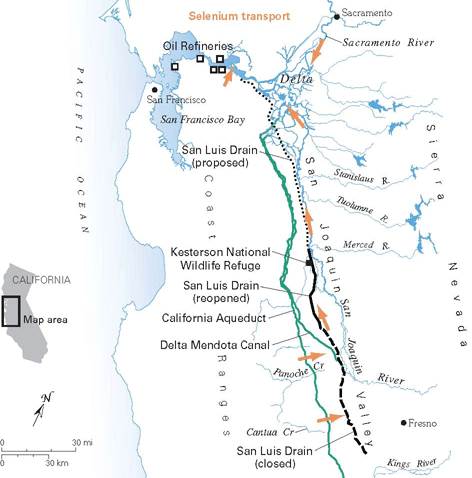
Draining Selenium Tainted Water from San Joaquin Valley
Source: USGS

II.  Selenium and irrigation in California.
The accumulation of selenium (Se) in the waste water draining from irrigated fields in the San Joaquin Valley has become a major problem in California water management, especially as there are only two readily available outlets for the waste water, 1) a  flow into the Sacramento Delta where the waste poisons water destined to be pumped into the California Water Project and then into San Francisco Bay where it threatens wildlife or 2) flow into the interior basin near Hanford where the water evaporates and the resulting brine and dusty soil have truly toxic levels of Se. Selenium and the San Joaquin Valley, a power point presentation from the Geochemistry program at the University of Arkansas, illustrates the sources of selenium and the problems associated with it. There have been a number of proposed solutions to the problem, including a drain into San Francisco Bay (see map above). The problem is far from resolved, and no easy solution is in sight.

Sacramento Delta

III. Salinization of the Sacramento Delta.
Drought caused low water flows and the heavy duty withdrawal of water from the Sacramento River for shipment southward has led to salt water intrusion into the large delta area at the mouth of the Sacramento Rive, the zone where it flows into San Francisco Bay. That salt water intrusion, in turn, threatens the quality of the water drawn into the San Luis Reservoir at the Harvey Banks Pumping Plant near Tracy in San Joaquin County on the edge of the Delta. The State of California has a Bay-Delta Conservation Plan which illustrates the various options currently under consideration to move water from the Sacramento River around the Delta so that it does not pick up salt. Only in California could a water movement proposal this expensive be given serious consideration!
Enhanced by Zemanta

25 October 2010

Sudan, the Nile and the Merowe Dam


The nearly always amazing NASA Earth Observatory chose this image of a dam in the desert on its site this morning as its Image of the Day. The accompanying brief article is well worth a read, for it encapsulates the problems of water supply and management in an extremely arid environment with a growing population. It also points to some of the problems of dams in the region and the conflicts over the use of the Nile, crucial for life in both Sudan and downstream Egypt.

06 October 2010

Notes VII

Mendoza, Argentina  ©eop

In our first session we talked about siltation and the failure of dams. Over the past week, a small dam in the Kingstowne section of Fairfax County failed draining small lake and leading to the death of wildlife. Fortunately no human lives or even housing units were damaged by the dam failure, but it left a mess that will require a substantial sum of money to repair. That break was not unexpected, for the dam was in need of rebuilding, and the lake behind it had been fouled by silt. Left behind is a swamp, probably a stinking swamp should warmer weather return in the next week or two. Dams, like all human devices for water control, need constant maintenance if they are to continue in service. Failure to maintain can lead to catastrophic collapse, and a dam failure can lead to loss of property and even loss of human life.

The last half of the session today, 6 October, and a substantial part of the next session on 13 October depend on a Power Point presentation developed by Prof. Arjen Hoekstra at the University of Twente in the Netherlands. To review the materials used today and to preview those to be discussed in the next session, the Power Point or a PDF version of it can be downloaded from the page: http://www.waterfootprint.org/?page=files/Presentations 

09 August 2010

Smoke, Trash and Dams

Three Gorges Dam, Yangtze River, China under construction below and nearly complete top

When it was proposed and during construction of the Three Gorges Dam, many commentators said it would fail to stem the floods for which the Yangtze is notorious. Since its completion the rains of summer 2010 mark the first season of precipitation greatly in excess of long-term averages, and events of the past two months would seem to prove their point. There has been substantial flooding both above and below the dam. Although the Chinese authorities claim the dam itself is sound,  it has been able to hold back only a small part of the additional flow of the massive river. Devastating flooding has wiped out towns and villages, farm fields, and transportation facilities both up and downstream from the world's largest barrage. Built for all four of the magic goals of dams, for the foreseeable future the Three Gorges Dam may fail at three of them, flood control, navigation, and hydroelectric generation, while the rains make the final one, irrigation, unnecessary.

Much of the detritus caused by the flooding, it turn, has washed into the river, and the dam has blocked that material coming from upstream in much the same way that it blocks silt in periods of normal flow. Upstream of the dam the accumulating trash in the reservoir, already about a meter thick and strong enough to form islands capable of supporting a person, could clog a floodgate and threaten the integrity of the dam itself, but more likely is blockage of the navigation locks (right hand side of the pictures) and fouling of the water flowing over and through the dam with trash that makes downstream use difficult. There are dire predictions about navigation dangers on the river, a crucial route for Chinese commerce, due to the accumulated trash. Upstream, the immense city of Chongqing (Chongqing (重庆; Chóngqìng formerly spelled Chungking), may have to draw water into its public supply that has been fouled by industrial and agricultural chemicals, farm waste, and human sewage. Rapid flow would serve to dilute those pollutants if the river had been left undammed, but the slack water behind dams results in far less mixing of waters and dilution of pollutants.

Meanwhile, at the opposite end of the rainfall spectrum, the severe drought and excessive heat that have plagued European Russia for most of the summer of 2010 have resulted in some serious problems of heat and smoke in the capital. Moscow, a city where air conditioning is rare because in the past it has been needed infrequently, has suffered multiple days with 35+ degrees Celsius. In addition to the heat, Muscovites are breathing air with dangerous levels of smoke, soot and other pollutants, a consequence of field, brush and forest fires, some of them burning down into the layers of peat beneath birch woods and brush lands surrounding the city. Peat, used as a fuel in several parts of the world, can smolder and burn for a long time once ignited, and until drenching rains or the winter cold begins, smoke will continue to plague Moscow even when temperatures moderate.

Most Russian grain is rain-fed with no supplemental irrigation, and the combination of drought and fires have devastated the 2010 crop. World grain prices have soared because analysts expect the grain crop in Russia to be far smaller than usual, and that country has banned grain exports. Increases in grain prices could spark serious food problems worldwide.Should the Argentinian and Australian grain areas suffer serious drought in the 2010-11 growing season, the year of 2011 could have a food crisis.


Temperature anomalies in Russia, Summer 2010

As always one must remember that the events of a single summer say nothing about climate change, but the flooding in Pakistan and China and the drought and heat in Russia are precisely the kinds of conditions that warmer earth temperatures point toward. Those include long spells of hot weather in many northern hemisphere cities, redistribution of precipitation with increases in some areas and deficits in others, and an increasing frequency of extreme weather events including both drought and torrential rainfall.
Enhanced by Zemanta

26 July 2010

Notes III

©EOP


In the posting about dams, I failed to note one major issue, the possibility of failure. Well-engineered dams rarely fail, but poor engineering, extreme weather events and lack of proper maintenance can lead to failures. In a few cases so can bad water management as illustrated by the first pages in Powell's Dead Pool, where the author describes what could have been a catastrophic failure of Glen Canyon Dam on the Colorado River.  Under the worst of circumstances, a catastrophic failure can lead to hundreds or even thousands of casualties. The most famous dam failure in the United States was at Johnstown, PA in 1889 when a badly maintained dam broke and killed 2,200 people. (That same benighted city had further floods in 1936 and again in 1977, devastating to property but not nearly as deadly for people, and neither was the consequence of a dam failure but rather of extreme weather.) Two days ago a small dam in Iowa collapsed after torrential rains. Knowing the failure was likely, deaths were apparently avoided, but several downstream towns had to be evacuated, and there was substantial property damage.

The St. Francis Dam, a water supply dam built in the early 1920s and designed by the famed California water engineer William  Mulholland, catastrophically failed on 12 March 1928 due to an engineering error. The ensuing flood killed 450 people and washed away towns and farms in the Santa Clarita Valley NW of Los Angeles.  Another badly engineered dam failure was the collapse of the irrigation retention  Teton Dam in Idaho in 1976 leading to 11 deaths and tremendous property damage downstream (see some pictures of the collapse on the website of a civil engineering faculty member at San Diego State University. Driving through the area later that summer, I stopped in Rexburg, Idaho to witness some of the devastation, but I have not scanned my slides as yet).

Shortly after posting the piece on glaciers yesterday, I read the New York Times (NYT) Sunday 25 July issue. While I am no fan of their regular columnist Thomas Friedmann,  he has an interesting op-ed  on global warming worth a read. This has been one of the hottest summers ever recorded in the eastern United States, and if current trends continue it could be the hottest yet recorded. Despite that heat (which it must be noted may be completely unrelated to climate change) the Senate has killed even the feeble climate legislation pending before it. Perhaps that is all to the well, for sometimes half measures like those in the bill now dead are worse than no action at all, but the lack of attention to the matter of climate change and the overuse of petroleum products in a hot summer with the Gulf oil gusher only temporarily capped is quite disturbing. It would seem those topics should be the subject of a national frenzy and demand for action. This morning's NYT has a good piece by their regular columnist and Nobel laureate Paul Krugman bemoaning the Senate's action, or or more exactly their lack of action placing a substantial share of the blame on the unprincipled ex-presidential candidate McCain and showing how the demands of the coal and petroleum oligopolies have trumped the public interest.

More water woes in the DC area. The drought may have broken for a time with heavy rains and strong winds accompanying a thunderstorm yesterday afternoon. The storm led to numerous electrical supply problems, and one facility loosing power was a major filtration facility of the Washington Suburban Sanitary Commission causing it to once again issue mandatory water usage limitations for Montgomery and Prince Georges Counties. While water supply systems are often discussed in the abstract and without reference to other elements of urban infrastructure, storms and other catastrophic events illustrate how interdependent those elements are.
Enhanced by Zemanta

21 July 2010

Dams - The Fascination of the Immense

Three Gorges Dam and Reservoir, Yangtze River, China, June 2009


Standing on the Nevada shore (being careful not to cross over into Arizona where one might be arrested as an enemy alien) and admiring the sleek arch and art deco works of the great Boulder Dam (aka Hoover Dam) across the Colorado it is difficult not to be awed at the power of humanity. Many years ago a famous architect working on one of the megalomaniac urban design projects for which his field is notorious said something to the effect "make no little plans for they have no power to stir men's blood."  The design project thankfully came to naught, but his statement still has power. Nowhere is that more true than in the construction of huge dams. The icons of the New Deal in the United States are large dams, from the impressive structures on the Tennessee River and its tributaries as a part of the TVA to the grandest two of all, Boulder Dam on the Colorado and Grand Coulée on the Columbia. Subsequently dictators, autocrats, and even a few leaders in nominally democratic states have ordered construction of immense dams including ones on most of Russia's great rivers, on the Nile, on the Paraná, and on China's Yangtze. The dams have been variously designed to prevent flooding, to improve navigation, to store water for irrigation, and to produce electricity, with most of them intended to do at least two of that magic four.

Immense dams have come with a set of problems, however. Blocking the normal flow of the river, they serve also to block the flow of silt, and it collects behind the dams. The Aswan Dams on the Nile have blocked the flow of silt onto Egypt's riverine fields. While they generate a huge amount of electricity, much of that is used to produce fertilizer to take the place of the silt that once made the Nile Valley a breadbasket. Meanwhile the Nile delta is rapidly receding (and Egypt is getting smaller) as it is not receiving silt from upstream. The huge dams on the Colorado in the United States are also rapidly silting, though the low flows of the past decade mean that silting has been slowed. Eventually silting will render the dams useless for water storage and degrade or eliminate their benefits of flood control, navigation, irrigation water storage, and hydroelectric production. All dams are subject to silting, but the problem is especially great on rivers like the Colorado and the Nile whose headwaters include areas of easily eroded materials like sandstone.

A motto of the early Soviet experiment was "socialism plus electricity equals communism," and the construction of immense hydroelectric dams was a key goal throughout the ill-fated Leninist-Stalinist pseudo socialist experiment. A year ago Sayano–Shushenskaya Dam, one of the huge dams in Russia built by the Soviets to produce electricity, experienced a large explosion in its powerhouse, flooding the powerhouse and among other things sending a plume of lubricant oil down the Yenisei toward the Arctic, destroying several turbines, and killing at least 74 people. For a time Russia's electricity supply was reduced by a sizable percentage, and several key export industries, including aluminum production, were harmed. The flooded powerhouse had ot be closed and repaired, a process still ongoing, though the dam is again producing electricity.

Yesterday evening BBC News America had a story on flooding in China, high water on the Yangtze below the world's largest dam. One of the functions of the dam was to prevent downstream flooding, but it would seem it is having almost the opposite result. At least according to Chinese authorities the dam itself, also intended to  is secure  Earlier it was discovered that large dams in China were creating earthquakes and might have been directly responsible for several large and deadly temblors.

One must hope the Three Gorges Dam is the final immense dam built on earth to improve navigation on the Yangtze, to store water for downstream irrigation, and to produce hydroelectricity. Given the predilictions of totalitarian governments that may be a vain hope, but accumulated evidence makes it clear that huge dams create problems far greater than those they are intended to resolve.


Enhanced by Zemanta