Showing posts with label Australia. Show all posts

29 September 2010

Second Class Session 29 September 2010

World Water Supplies: The Coming Crisis
Mendoza, Argentina ©eop

Session II: The Physical Geography of Water Supplies: Some Illustrative Materials


Thanks to a computer glitch, three videos I had wanted to use with the session were unavailable.  Below are those videos and a couple of notices. I shall post the outline of the session in a day or two.


I. World rainfall by Month, 1998-2009
Source: NASA Earth Observatory

II. World Snow Cover

Source: NASA Earth Observatory

3. Great Artesian Basin of Australia


Source: Government of Australia

The following information is thanks to one of our class members:
"Liquid Assets - The Big Business of Water   'The host explores the coing water crisis as fresh water becomes harder to find"  CNBC Thursday 30 October 9-10 pm
According to other class embers CNBC is available at Channel 68 on Cox cable and 102 on Verizon. The CNBC website does not give much additional information, but it sounds as if the broadcast will be worth watching.


Once again, by next session 6 October, please work out your water footprint. Go to the website at http://www.waterfootprint.org/?page=cal/WaterFootprintCalculator

24 July 2010

Irrigation and Salt

Wind eroded and salt encrusted hoodoos, Atacama Desert, Chile
©EOP

For the past several days I have been wracking my memory and rifling my notes to find the first time I encountered the "3 s" of irrigation - silt, salt and [political] stability. The idea is so straightforward that perhaps the term has been around forever, or at least as long as supplemental water has been used to grow crops. Salt and silt threaten the utility of irrigation works and the soils to which water is applied, while political stability is required if irrigation works are to be maintained over time. Irrigation at any significant scale is a cooperative activity requiring many people to participate in the construction and upkeep of the impoundments to store water, the canals to bring it to fields, and the drains to remove excess water and prevent water-logging of soils. Archaeology and history provide numerous examples of cases where irrigation systems fell into disrepair because soils became too saline for use, because impoundments and canals were clogged with silt, or because political unrest made it impossible to maintain the irrigation works. On occasion the destruction of irrigation works has been a deliberate ploy in warfare as an enemy attempts to starve a population by destroying its agriculture.

Silting behind large dams was noted in the posting on immense dams. It is also a problem behind even the smallest hydraulic barriers and unless water is moving rapidly, it can be a problem in canals as well. In a later posting we shall examine that idea in a bit more detail. In later postings and in the lectures we shall also examine the importance of political stability in the maintenance of irrigation systems.

Today I would like to make a few comments about salt as an enemy of irrigation projects. Salinization is a complex problem for all water systems. Many mineral salts, including the most important single one NaCl or sodium chloride (common table salt), dissolve readily in water. At low concentrations those salts can be be inconsequential or even beneficial for human consumption and agricultural use. At some level of concentration, however, they become a problem, and beyond some maximum concentration the water is no longer useful. We may look at salts other than NaCl later, but for today let us limit discussion to it.

Crop plants vary greatly in tolerance to saline soils and salty water. Grains and grasses tend to be more tolerant than other field crops, while most tree crops are intolerant of saline conditions. When land is being considered for irrigation, an early test is of the natural salinity of the soil recognizing that high value fruit, vegetable, fiber and tree crops are unlikely to thrive if the soil is already quite saline. Grain crops in general do not return enough value per hectare to justify investment in irrigation facilities.

Salts accumulate in soils through a variety of processes, and some soils are naturally saline, especially ones derived from rock substrates containing high levels of salt. Elsewhere in arid areas evaporation of surface ponds and lakes leads to pockets of salty soil (often called playas in Mexico and the southwestern US  and salinas in South America). Once overlain by glaciers, with numerous small ponds and lakes left as the glaciers receded the now semi-arid southern part of the Canadian province of Alberta, its agricultural area, has salty soils spread quite widely. Some of those soils derive from salty substrates, while other areas were once covered by waters now evaporated away. As grains and grass fed livestock are the primary agricultural products, the presence of salty soil is not a great hindrance to agriculture in Alberta (uncolored areas on the map are generally unsuitable for agriculture for other reasons, while blue areas are lakes and streams).

Source: Agriculture Canada and Province of Alberta

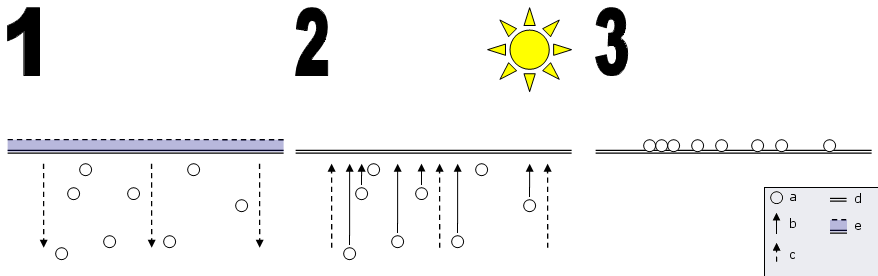
Commonly soils become salty after irrigation commences. Not infrequently in arid areas the water used for irrigation is itself  saline. Rainwater dissolves salt as it flows across desert landscapes in infrequent storms. Water captured in impoundments becomes increasingly saline as evaporation occurs. The extremely high rate of evaporation in hot desert areas like those of the southwestern US mean that water leaving Lake Powell or Lake Mead is far saltier than water flowing into those reservoirs. Applied to the soil in areas with high rates of evaporation, some salt from that water is added to the soil with irrigation. Much of the salt is leached to lower levels in the soil profile, and some of that, in turn, is washed away. But water retained in the soil can be  returned to the surface in a capillary process as water is drawn upwards to the soil surface by evaporation.

Rain or irrigation, in the absence of leaching, can bring salts to the surface by capillary action
Source: Wikipedia Media Commons

Only if it is possible to flush the salts by using a large quantity of water to redissolve the salts and thus to remove them can the eventual salinization of the soils be prevented. Accumulation of salt in soils has rendered substantial areas once productive agricultural zones into salty desert too saline for crops. In the Middle East and in arid parts of Asia, many square kilometers of once productive agricultural activity have been abandoned because of salinization. 

Source: Australia Department of Agriculture, Fisheries and Forestry, Bureau of Rural Sciences

While irrigation agriculture is fairly new to Australia, the Murray River Basin in the southeastern quadrant has been irrigated for more than a century. Not surprisingly, that arid area is reporting salinity problems as the map illustrates.

26 June 2010

Artesian Water

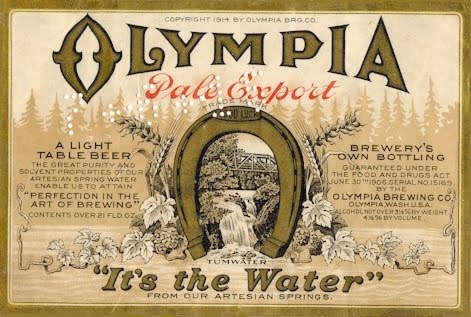
The beer was brewed until the 1980s in Tumwater, Washington (adjacent to Olympia) using artesian water, or so the brewery claimed. Today that beer brand is brewed in Southern California.

From the time I was a small child I remember people talking about artesian water, and until I was almost an adult I believed that it was somehow different from standard surface water or the water coming out of the tap. Advertising, including that for a popular brand of beer in the Puget Sound region, suggested that somehow artesian water tasted better or was more healthful. Based on marketing for Fiji water, a widely distributed brand of bottled water, that misconception persists.  In fact artesian is a description of the source and not of the water itself. Artesian water can be almost pure or nearly saturated with chemicals. Its primary trait is that it came from an underground aquifer where water is under pressure. When the aquifer comes to the surface a flowing or artesian well occurs. Many springs are of this sort.

A diagram of an artesian system where ground water is under pressure and rises to the surface when there is an opening. Source: http://www.littledippers.com/geocaching/ArtesianWell.jpg

Artesian wells are often a selling point for a property, especially a large property to be used for grazing where permanent surface water is distant or rare. In arid areas artesian seeps and wells are often the only source of water for many kilometers and thus are especially prized. In a later posting I plan to write a little about Australia's Great Artesian basin. The intense aridity of the outback would preclude almost all human use in many areas were it not for the water the artesian flow provides.

Artesian wells are but one aspect of ground water, a topic about which I shall have a great deal to say.

31 May 2010

Desalination

Sydney, Australia desalination plant


A longstanding dream of water users in arid areas close to the ocean and other salt water bodies has been the easy and cheap desalination of salty water. Desalination is possible by the ancient process of distillation and capture of the salt free steam for condensation, but that process is energy intensive and thus only useful when small amounts of water are needed or energy is really cheap. A technology called flash distillation has allowed energy requirements to be lessened somewhat. A quite different technique called reverse osmosis uses special filters and pressure differentials to desalinate water, a common technique for small plants but also used in large ones. It is claimed to use less energy than flash distillation. Both flash distillation and reverse osmosis require expensive facilities. The Sydney plant shown above cost A$1.7 billion (Puroserve).


Saudi Arabia is the largest user of desalinized water, and nearly 3/4 of the water consumed in Saudi Arabia is desalinated, using a little of its ample supplies of petroleum and natural gas to power flash distillation facilities.  Some of the distilled water is also used for agricultural irrigation in the extremely arid portions of the theocratic kingdom. Even oil rich Saudi Arabia is now looking for other energy sources to desalinate water and has contracted for a solar powered plant, sunshine being abundant in the Saudi desert. Most Saudi plants are close to the coast, but a few also operate in the interior using salty ground water.

The city of Sydney in Australia recently brought a large desalinization plant online, a reverse osmosis facility capable of meeting about 15 per cent of the city's water demand. The plant was built and is operated by the Paris based Veolia corporation (formerly Vivendi Environnement, having been spun off from Vivendi. Prior to 1998 Vivendi was known as Compagnie Générale des Eaux (Wikipedia)).  Veolia sells water supply and management services to a number of cities around the world. Growing populations, climate change, and inadequacies of current supplies have prompted several coastal cities in various countries, including Santa Barbara, California, to use one or another type of desalination to meet part of local demand.


A crucial issue in desalination is the disposal of the brine resulting from the process. Much saltier than sea water, the brine can be toxic to marine life when dumped undiluted into the ocean. 


The same processes used to desalinate sea water can also be used to purify sewage and other contaminated water, but the problems of energy demand and waste disposal remain. For the next few decades desalination is likely to remain a small  source for human water supplies, limited to energy rich regions and to places where the price of water is high enough to justify the costs per liter supplied.